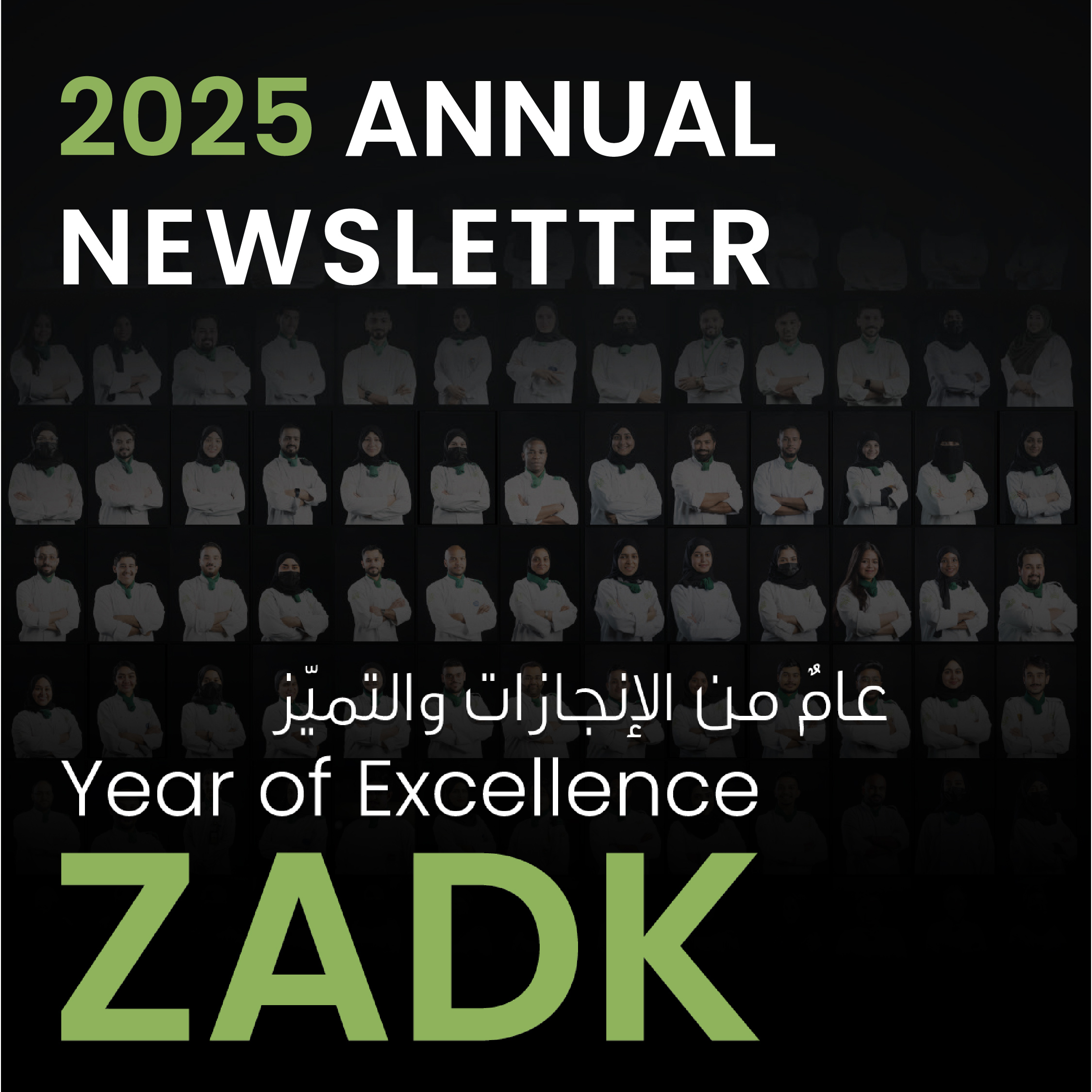
Dive into our latest ZADK Annual Newsletter for 2025, now available in an interactive, easy-to-read flipbook format!
For full screen access, kindly click here.







Dive into our latest ZADK Annual Newsletter for 2025, now available in an interactive, easy-to-read flipbook format!
For full screen access, kindly click here.
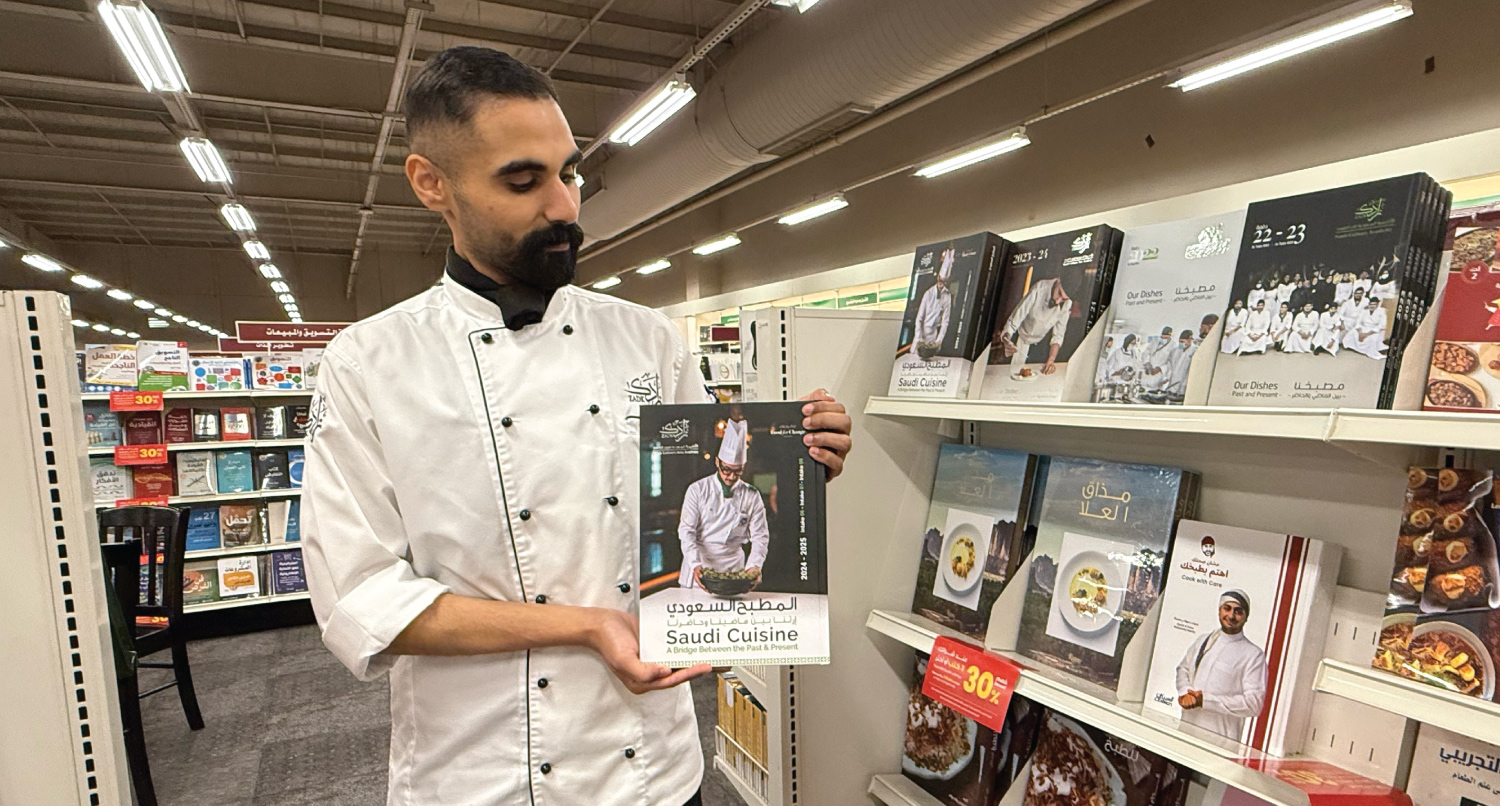
Our latest book, “Saudi Cuisine: A Bridge Between the Past & Present”, is now available at Jarir Bookstore. Among our previous publications already featured there, this book highlights the rich culinary heritage of Saudi Arabia, connecting traditional recipes with modern interpretations.
It is a celebration of flavors, culture, and innovation in Saudi cuisine.
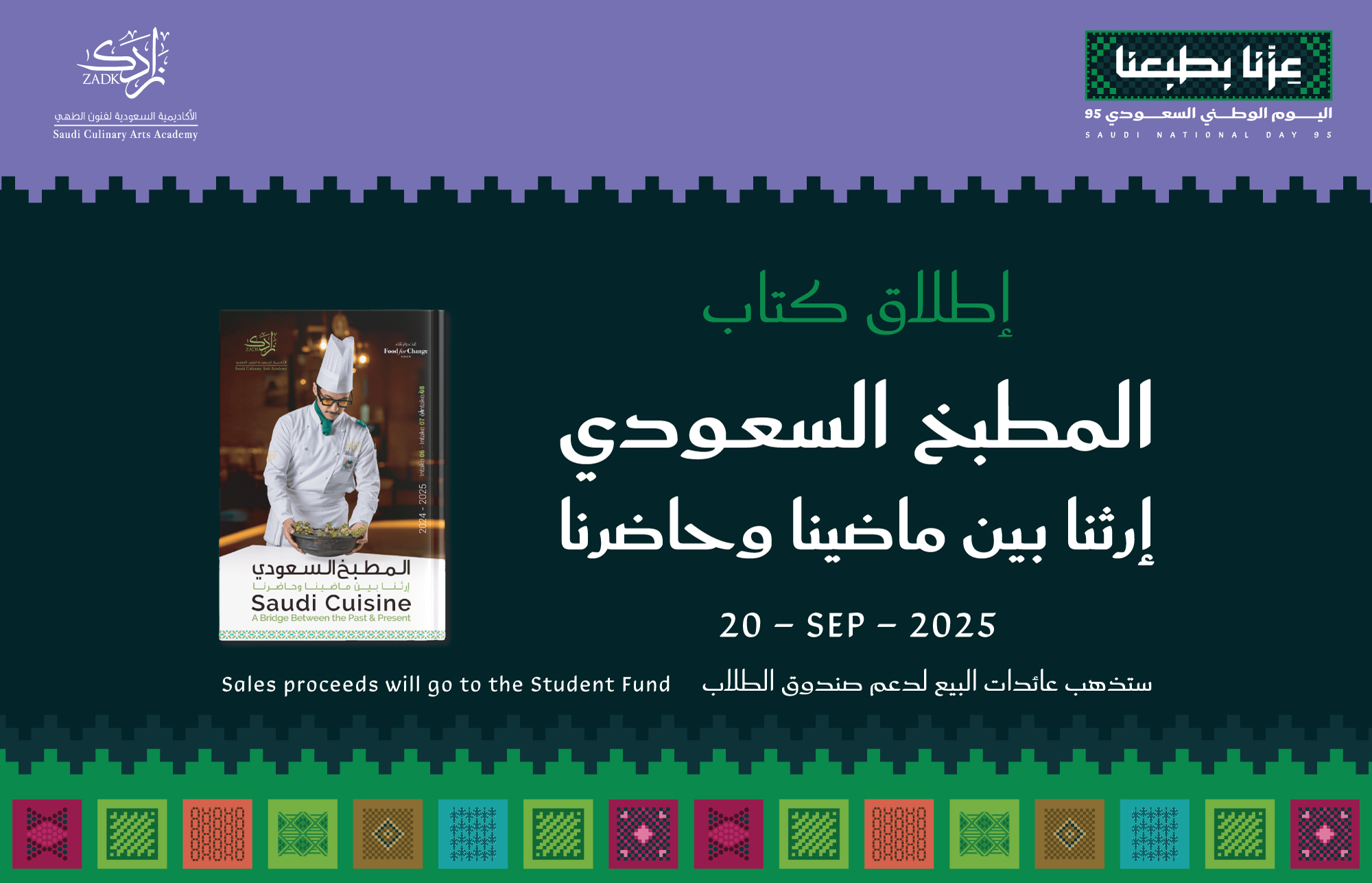
ZADK is proud to announce the launch of its newest publication, “Saudi Cuisine – A Bridge Between the Past & Present.” This special edition features 77 authentic recipes from across the Kingdom and shares inspiring stories of our graduates from intakes 06, 07, and 08 (2024–2025).
The book celebrates Saudi culinary heritage, presenting it through the lens of today’s innovative chefs and the bright talents of ZADK’s alumni. It is a testament to our mission of connecting tradition with modernity, and of empowering a new generation of culinary leaders.
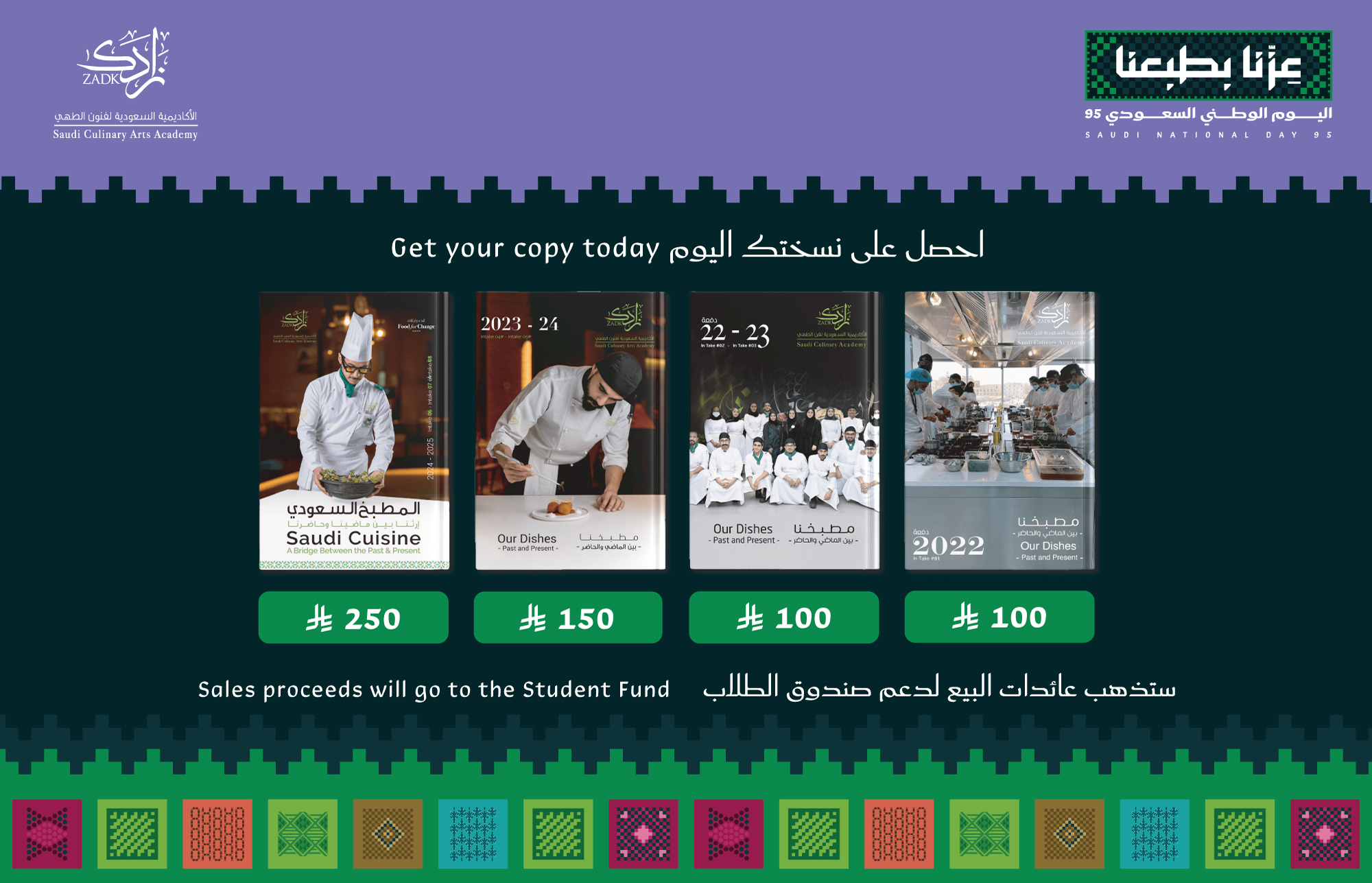
In celebration of Saudi National Day, the newest publication, “Saudi Cuisine – A Bridge Between the Past & Present.” and other ZADK books will be available for purchase during the celebration on Saturday, 20 September 2025:
All income from these books will go directly to the Student’s Fund in support of our learners.
Join us in celebrating Saudi heritage, supporting our students, and taking home a piece of culinary history crafted by the next generation of Saudi chefs.
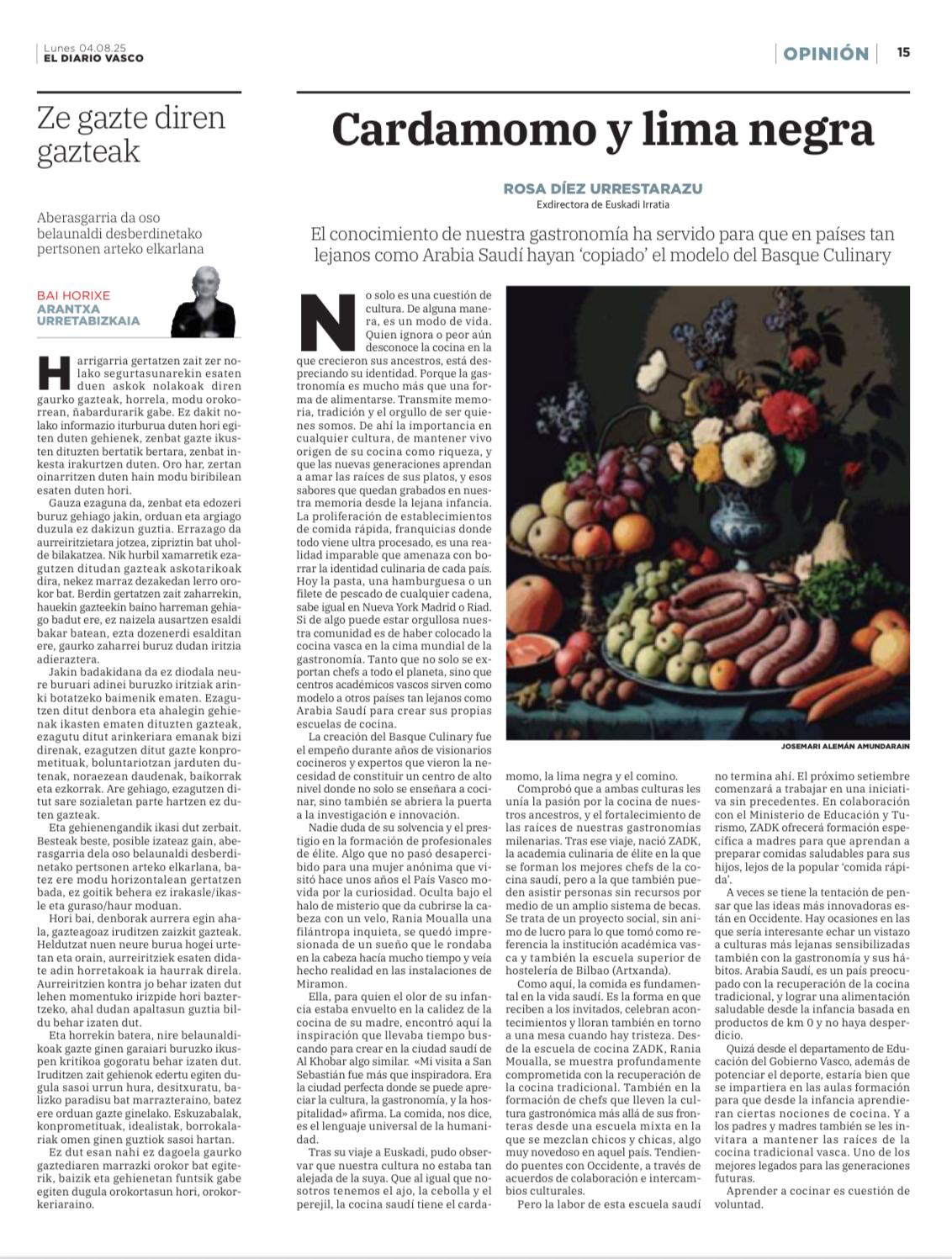
This article was published in Diario Vasco, the leading newspaper in San Sebastián — widely known as the culinary capital of the world! It highlights ZADK and proudly recognizes the contributions of our Founder & Chairwoman, Mrs. Rania Moualla.
The journalist was particularly impressed by ZADK’s strategic vision, its impactful initiatives, and the inspiring leadership and passion of Mrs. Rania. This recognition strengthens ZADK’s growing reputation and serves as a testament to the meaningful work being accomplished.
The article in Spanish can be found here.
Enjoy the read!
The English version for non-Spanish speakers
Written by : Rosa Diez Urrestarazu .
Published on August 4 , 2025
It’s not just a matter of culture. Somehow, it is a way of life. Whoever ignores or worse still does not know the culinary tradition in which their ancestors grew up, is despising their identity. Because gastronomy is much more than a way of eating. It transmits memory, tradition and pride in being who we are. Hence the importance in any culture, of keeping alive the origin of its cuisine as wealth, and that the new generations learn to love the roots of its dishes, and those flavors that remain engraved in our memory since the distant childhood.
The proliferation of fast food establishments, franchises where everything is ultra-processed, is an unstoppable reality that threatens to erase the culinary identity of each country. Today the pasta, a hamburger or a fish steak of any chain, tastes the same in New York Madrid or Riyadh.
If anything our community can be proud of is having placed Basque cuisine at the top of the world gastronomy. So much so that not only are chefs exported all over the world, but Basque academic centers serve as a model to other countries as far away as Saudi Arabia to create their own cooking schools.
The creation of the Basque Culinary Center was the commitment for years of visionary chefs and experts who saw the need to establish a high-level center where not only cooking was taught, but also the door to research and innovation was opened.
Nobody doubts its solvency and prestige in the training of elite professionals. Something that did not go unnoticed for an anonymous woman who visited the Basque Country a few years ago, driven by curiosity. Hidden under the halo of mystery of covering her head with a veil, Rania Moulla, a restless philanthropist, was impressed by a dream that had been around her head a long time ago and saw a reality in the Miramón facilities.
She, for whom the smell of her childhood was wrapped in the warmth of her mother’s kitchen, found here the inspiration she had been looking for to create something similar in the Saudi city of Al Khobar. “My visit to San Sebastian was more than inspiring. It was the perfect city where you can appreciate culture, gastronomy, and hospitality” he says. Food, she tells us, is the universal language of humanity.
After her trip to the Basque Country, she could observe that our culture was not so far from her own. That like us we have garlic, onion and parsley, Saudi cuisine has cardamom, black lime and cumin.
She found that both cultures were joined by the passion for the cuisine of our ancestors, and the strengthening of the roots of our ancient gastronomies. After that trip, ZADK was born, the elite culinary academy where the best chefs of Saudi cuisine are trained, but which can also be attended by people without resources through a scholarship system. It is a non-profit initiative for what was taken as a reference by the Basque academic institution and also the higher school of hospitality in Bilbao, (Artxanda).
As here, food is fundamental in Saudi life. It is the way in which they receive guests, celebrate events and also cry around a table when there is sadness. From the ZADK cooking school, Rania Moulla, is deeply committed to the recovery of traditional cuisine. Also in the training of chefs who take the gastronomic culture beyond its borders from a mixed school in which boys and girls are mixed, something very new in Saudi Arabia. Building bridges with the West, through collaboration agreements and cultural exchanges.
But the work of this Saudi school does not stop there. Next September will start working on an unprecedented initiative. In collaboration with the Ministry of Education and Tourism, ZADK to provide specific training for mothers to learn how to prepare a healthy meal for their children, far from the widespread “fast food”.
Sometimes you are tempted to think that the most innovative ideas are in the West. There are occasions when it would not hurt to take a look at more distant cultures also sensitized to gastronomy and their habits. In Saudi Arabia, a country worried about rising obesity, wants to address this problem from childhood. From education, with specific training for it.
Perhaps from the education department of the Basque Government, in addition to promoting sport, it would be good to provide training in the classrooms so that from childhood they learn food what is better to have certain notions of cooking. And parents will also be invited to keep the roots of the kitchen of our amonas. One of the best legacies for future generations.
Learning to cook is a matter of will.
We’re proud to share this wonderful feature by The Urban Activist, highlighting ZADK’s role in empowering women through culinary arts. The article offers an insightful look into our vision and how culinary education is shaping lives.
“It’s not just about cooking — it’s about confidence, culture, and change.” – The Urban Activist
In a male-dominated profession, Rania Moualla stands as a transformative figure behind ZADK, Saudi Arabia’s first Culinary Arts Academy. Combining her passion for food with a mission for social change, Moualla has created a space where Saudi youth, both men and women, learn to celebrate their culinary heritage while embracing modern techniques. Through initiatives like zero-waste cooking, community engagement, and empowering female chefs, the academy is shaping the future of gastronomy in Saudi Arabia.
Explore how this remarkable academy is preserving traditions, creating opportunities, and redefining culinary education in Saudi Arabia.
Continue reading the full article here:
https://theurbanactivist.com/idea/hidden-recipes-inside-a-womans-culinary-academy-in-saudi-arabia